
About the Author
Written by the Aconwell Pharma editorial team, drawing on over a decade of hands-on PCD franchise operations across North and South India. We work directly with franchise partners on pricing, monopoly territory allocation, and order planning this guide reflects patterns we see in real partner accounts, not textbook theory.
Quick Answer: PCD Pharma Franchise Profit Margin
Margins run 15%-50% on MRP depending on product category — general tablets sit at 15%-25%, while injectables, derma, and neuro-psychiatry climb to 30%-50%.
In rupees: ₹40,000/month orders → ₹8,000-10,000 profit. ₹1.5 lakh/month → ₹37,500-45,000. ₹4 lakh+ → ₹1.2 lakh+ profit.
The real deciding factor isn’t the margin % — it’s doctor coverage. A 25% margin franchise with strong prescriber relationships beats a 40% margin one with flat sales. Check doctor density in your territory before signing.
Let’s accept it.
Profit is one of the top priorities while starting any business. And running a pharma venture is no exception, especially when it comes to a PCD pharma franchise. Of course, yes. A PCD pharma franchise is a profitable model. But how much margin can you expect? That’s the real question. You should know how to figure it out. This guide breaks down PCD pharma franchise profit margin in India, step by step. By the end, you will know how to check your return before signing any agreement. Let’s get started.
What is PCD Pharma Franchise Profit Margin in India?
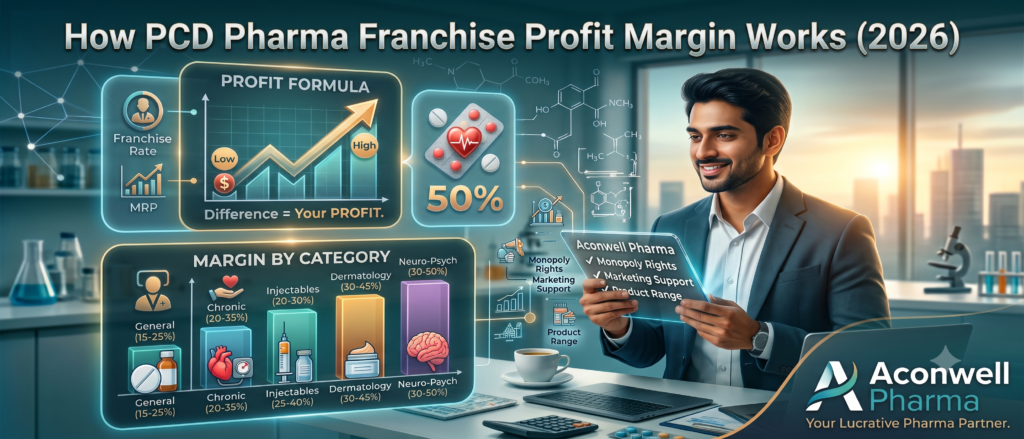
In simple words, PCD pharma franchise profit margin in India is the gap between your buying rate and the MRP.
You buy stock at a lower “franchise rate.” You sell it at MRP through doctors, chemists, and hospitals. You keep the difference as profit. For example, you buy a bottle of cough syrup from your pharma company at a franchise rate of INR 35. You sell it to the chemist at INR 100. This way, your gross profit per bottle will be INR 85.
There is no royalty fee. There is no revenue-sharing. There is also no strict monthly target, unlike most franchise models. This simple setup is why PCD pharma franchise profit margin in India stays higher than most small businesses can offer.
Pharma Franchise Business Profit Percentage: The Simple Formula
The pharma franchise business profit percentage is easy to work out. You just need two numbers: your net rate and the MRP.
Formula: Profit Margin (%) = [(MRP − Net Rate) ÷ MRP] × 100
Here is a worked example, using a common cardiac tablet strip:
| Item | Value |
|---|---|
| MRP printed on strip | ₹120 |
| Net rate charged by company | ₹60 |
| Profit per strip | ₹60 |
| PCD Pharma Franchise Margin on MRP | 50% |
Sell 500 strips a month. Your gross profit from this one product is ₹30,000. That is before free samples, bonus stock, and quarterly incentives. Most companies add these on top.
This is the core reason PCD pharma franchise profit margin in India attracts so many first-time entrepreneurs, medical reps, and retired professionals. They all want a low-risk business.
PCD Pharma Franchise Margin on MRP: Category-Wise Breakdown
Not every medicine carries the same margin. Fast-moving products with heavy competition carry thin margins. Special or chronic-care products carry fat ones. Industry ranges usually look like this:
| Product Category | Typical Margin on MRP |
|---|---|
| General tablets & syrups (antibiotics, painkillers) | 15% – 25% |
| Chronic-care tablets (diabetes, hypertension) | 20% – 35% |
| Injectables | 25% – 40% |
| Dermatology & cosmeceutical range | 30% – 45% |
| Neuro-psychiatry & specialised segments | 30% – 50% |
Note: these are broad, illustrative ranges seen across the industry. Your real PCD Pharma Franchise Margin on MRP always depends on the company’s pricing policy and your state.
PCD Pharma Franchise Profit Margin by State: Where the Numbers Actually Shift
Margins don’t stay flat across India — Punjab, Haryana, and UP run tighter than the industry average because franchise density is high and price wars are common on fast-moving brands. A general tablet range that fetches 25% margin in a low-competition state like Bihar or Odisha might settle at 15-18% in Ludhiana or Karnal, simply because five other franchise holders are pushing the same molecules in the same market.
South India tells a different story. Kerala and Tamil Nadu see steadier margins on chronic-care and specialty ranges — partly because prescription patterns favor branded generics over aggressive substitution, which keeps price-cutting pressure lower.
| Region | Margin Trend | Why |
|---|---|---|
| Punjab, Haryana, UP | 10-20% (tighter) | High franchise density, brand-vs-brand price competition |
| Bihar, Odisha, NE states | 25-35% (wider) | Fewer competing franchises, less price pressure |
| Kerala, Tamil Nadu | 20-30% (steady) | Strong prescription loyalty, slower substitution |
| Rajasthan, MP | 20-28% (moderate) | Growing demand, moderate competition |
None of this is fixed — a monopoly-based agreement in a saturated state can still land you a 30% margin if the company hasn’t oversaturated your specific district. Before signing anything, ask how many other franchise holders the company already has within a 50km radius. That single question tells you more than any margin percentage on the agreement.
PCD Pharma Franchise Investment vs. Return: What the Numbers Look Like
This is where most beginners get confused. A high margin per cent means little if your monthly order stays small. So, “PCD Pharma Franchise Investment vs. Return” should be read together, not apart.
| Investment Level | Typical Monthly Order Value | Approx. Margin | Est. Monthly Profit |
|---|---|---|---|
| Starter (₹30,000 – ₹50,000) | ₹40,000 | 20% – 25% | ₹8,000 – ₹10,000 |
| Growing (₹1,00,000 – ₹2,00,000) | ₹1,50,000 | 25% – 30% | ₹37,500 – ₹45,000 |
| Established (₹3,00,000+) | ₹4,00,000+ | 30% – 40% | ₹1,20,000+ |
A good way to find your profit/return on every investment is to track your order growth, quarter over quarter. Do not just look at the margin printed on your agreement. A franchise with a 20% margin and steady, rising orders often beats a 40% margin franchise with flat sales.
Gross Margin vs Net Profit: What You Actually Take Home
A 30% margin on paper rarely means 30% in your pocket. Between GST, freight, stockist commission, and the odd batch that expires before you sell it, real take-home usually runs 5-10 percentage points below the printed margin.
Here’s how it breaks down on a ₹1,00,000 monthly order at a 30% gross margin:
| Deduction | Typical Cost | Impact |
|---|---|---|
| Gross profit (30% margin) | ₹30,000 | Starting point |
| GST input/output adjustment | ~2-3% | -₹2,000 to ₹3,000 |
| Freight & logistics | ~3-5% | -₹3,000 to ₹5,000 |
| Stockist/sub-distributor commission (if applicable) | ~5-8% | -₹5,000 to ₹8,000 |
| Expiry & breakage losses | ~1-3% | -₹1,000 to ₹3,000 |
| Realistic net profit | — | ₹15,000 – ₹20,000 |
That’s roughly half your gross margin, and it’s the number that should actually decide whether a franchise offer is worth it — not the headline percentage on the agreement. A company offering 40% gross margin but routing everything through a sub-stockist can leave you with less net profit than a straightforward 25% margin deal with no middleman. Ask for the net numbers, not just the printed margin, before you commit.
How Much Profit in Pharma Franchise Business Can You Realistically Expect?
There is no single answer to how much profit in pharma franchise business you can make. Every territory is different, and PCD pharma franchise profit margin in India can shift with local demand. Still, the outcome depends on four moving parts:
Product mix
A wider range of chronic and special molecules lifts your average margin.
Doctor coverage
More prescribing doctors in your area means faster stock turnover.
Payment terms
Credit cycles from your company free up cash for reordering.
Monopoly rights
An exclusive area stops other franchise holders from cutting your prices.
Partners who manage all four well often see their profit double in twelve to eighteen months. This growth comes mainly from repeat prescriptions and word-of-mouth from local chemists.
Factors That Push Your Margin Up or Down
● Bonus schemes (like 10+1 or 20+2 free stock) raise your real margin above the printed number.
● Freight and stockist commissions eat into your profit if you also distribute further.
● Poorly managed stock can lead to expiry and breakage losses eating into margin.
● Price competition at state level, as seen in Punjab, Haryana and Uttar Pradesh, can lead to margin squeeze on fast-moving brands.
Aconwell Pharma: The Reliable Partner Makes the Difference
Aconwell Pharma is a reliable pharma company ensuring a lucrative PCD pharma franchise opportunity. We offer a wide range of WHO-GMP certified products that are easily accepted by doctors or other healthcare professionals. Secondly, we provide you with monopoly rates, meaning that you will be the sole vendor or distributor in a certain area. You can grow without any competition. We also offer you promotional support such as Visual aids, MR bags and free samples to help you find new clients easily. To learn more, contact us at +91-7027453331.
Final Word
PCD pharma franchise profit margin in India is attractive. However, it depends on certain factors like your pharma company’s policies and demand for the product you sell. One thing is for sure: it rewards patience and steady fieldwork, not quick shortcuts. Always work with a good, certified company and build your networks to see your margin go up month after month.
Frequently Asked Questions
Q1. What is a fair PCD Pharma Franchise Profit Margin in India for a beginner?
Ans. Most beginners can expect a pharma franchise business profit percentage of 15% to 30% in year one. It depends on product mix and territory.
Q2. How is PCD Pharma Franchise Investment vs. Return usually calculated?
Ans. It is calculated by inputting your one-time and recurring costs along with your monthly order value and net profit over a 6-12 month period.
Q3. Which product categories provide the highest margins?
Ans. Neuro-psychiatry, dermatology and injectable ranges usually offer a higher PCD Pharma Franchise Margin on MRP than plain tablets and syrups.
Q4. How much profit in pharma franchise business is possible in year one?
Ans. With a steady footfall of doctors and a focused product list, many partners are making a monthly profit of ₹15,000 to ₹50,000 by the end of year one.
Q5. What Is the Difference Between Profit Margin and Trade Margin in a PCD Pharma Franchise?
Ans. Trade margin is simply company rate to MRP the number on the price list. Profit margin is what actually lands in your pocket once transport, marketing, and running costs take their cut. Fat trade margin, thin profit margin happens all the time.
Q6. Does a Higher Profit Margin Always Mean Higher Income?
Ans. No. Chase the biggest margin number and you might still end up earning less. Doctor relationships, repeat prescriptions, steady monthly orders that’s what actually fills the bank account, margin percentage or not.
Q7. How Long Does It Take to Earn Profits from a PCD Pharma Franchise?
Ans. Usually 3 to 6 months before profit becomes regular. Doctor coverage, product demand, how hard you push marketing, how consistent your sales are these decide which end of that range you land on.