Quick Answer
A WHO-GMP certified PCD pharma company in India is a manufacturer whose production facility has passed World Health Organization Good Manufacturing Practice inspection — covering raw material handling, hygiene, equipment, staff training, and batch testing — and which offers franchise partners monopoly-based distribution rights over its product range. Before signing with one, verify the certificate number directly on your state drug authority’s website or CDSCO, confirm monopoly rights are in writing, and check the product range against what your target market actually needs.
Picking the wrong manufacturing partner doesn’t just cost you money — it costs you the trust you’re trying to build with doctors and chemists in your territory. This guide walks through what WHO-GMP certification actually verifies, how to check it yourself in ten minutes, and what separates a partnership that lasts from one that falls apart within a year.
What Is a WHO-GMP Certified PCD Pharma Company?
WHO-GMP (World Health Organization – Good Manufacturing Practice) certification confirms that a pharmaceutical manufacturing facility has been inspected against internationally recognized quality standards — not just the finished product, but the entire process behind it: raw material sourcing, factory layout, equipment calibration, staff hygiene protocols, and batch documentation.
A PCD (Propaganda Cum Distribution) pharma company that holds this certification manufactures its own range under those standards, then grants individuals or businesses the right to market and distribute those products under the company’s brand name within a defined territory — usually with monopoly protection, meaning no other franchise partner from the same company competes with you in your area.
Put together, a WHO-GMP certified PCD pharma company is one where the manufacturing side has passed an internationally recognized quality bar, and the business side lets you build a distribution business on top of that without you having to manufacture anything yourself.
Why WHO-GMP Certification Matters When Choosing a PCD Company
Certification isn’t a formality — it’s the single factor that determines whether the medicine reaching a patient’s hands is what the label says it is. For a franchise partner, that has three direct, practical consequences:
- Fewer complaints and returns. Batch-to-batch consistency means what you sold last month performs the same as what you sell this month.
- Faster doctor trust. Physicians and chemists recognize WHO-GMP as a baseline they can rely on, which shortens the trust-building period for a new franchise partner in a new territory.
- Lower regulatory exposure. Distributing products from an uncertified or loosely certified facility puts your own drug license at risk if quality issues surface.
None of this is about brand reputation in the abstract — it’s about whether your business survives its first difficult quarter.
How to Verify Whether a Pharma Company Is Actually WHO-GMP Certified
A certificate shown to you on a screen or in a PDF proves very little on its own. Verification takes about ten minutes and should happen before any conversation about territory or pricing goes further.
- Request the certificate copy — check the company name, manufacturing unit address, issue date, and expiry date. WHO-GMP certificates are typically valid for three years.
- Cross-check the certificate number on your state Drug Control Department’s website, or on the central CDSCO portal (cdsco.gov.in).
- Match the manufacturing address on the certificate against what’s listed in the regulatory database — a mismatch is a red flag, not a clerical error to overlook.
- Ask for the Drug Manufacturing License separately. WHO-GMP certification and the manufacturing license are two different documents, and a legitimate company will have both readily available.
- Walk away if there’s hesitation. A genuine WHO-GMP holder shares this information without friction. Stalling, vague answers, or “we’ll send it later” is the tell.
What to Check Before Choosing a PCD Pharma Franchise Company
Certification is the starting filter, not the finish line. Once that’s confirmed, evaluate the partnership itself against these factors:
| Factor | What to Look For |
|---|---|
| Certification | Valid WHO-GMP, verified independently — not just claimed |
| Product Range | Covers the therapy areas your target doctors actually prescribe |
| MOQ | Minimum order that matches your actual sales capacity, not just the company’s preferred order size |
| Pricing | Printed price list, no hidden margins added later |
| Monopoly Rights | Written into the agreement, with your exact territory named |
| Packaging | Matches what doctors and patients expect for that product category |
| Delivery | A stated, realistic timeline — and a track record you can verify with existing partners |
| Marketing Support | Visual aids, sample kits, MR bags, and promotional material actually included, not just promised |
| Documentation | Company provides drug license, GST details, and product list without pushing for a signature first |
| Customer Support | Responsive before you sign — which tells you a lot about support after you sign |
WHO-GMP vs GMP vs ISO: What’s the Real Difference?
These three get confused constantly, and the confusion costs franchise partners real money when they assume one certification covers what another actually verifies.
| Certification | What It Actually Verifies | Issued By |
|---|---|---|
| GMP | Basic manufacturing practice standards, often a national-level requirement | National/state drug authorities |
| WHO-GMP | International-standard manufacturing practice — a stricter, globally recognized version of GMP | Assessed against WHO guidelines, tied to the drug regulator |
| ISO 9001 | Quality management systems around the business — documentation, complaint handling, process consistency | International certification bodies |
A company can hold ISO certification and still fall short on manufacturing quality, because ISO evaluates the business process, not the drug itself. WHO-GMP is harder to fake because it’s tied directly to facility inspection by the drug regulatory system. If you can only verify one certification before moving forward, make it WHO-GMP — it speaks directly to whether the medicine is safe.
How a PCD Pharma Franchise Works in India
The model is straightforward once you see the moving parts:
- A pharmaceutical company manufactures its product range under its own brand.
- It offers franchise partners (individuals, distributors, or small businesses) the right to market and sell that range within a defined territory.
- The franchise partner invests in initial stock, promotional materials, and local market-building — not in manufacturing infrastructure.
- In exchange for monopoly rights in that territory, the partner commits to purchasing from the company and representing the brand locally.
This is what makes PCD accessible: you’re not raising capital for a manufacturing plant, drug licenses for production, or a quality control lab. You’re building a distribution business on top of an already-certified supply chain.
What Products and Product Categories Should You Expect?
A well-rounded PCD pharma company typically manufactures across multiple dosage forms and therapeutic categories, which matters because your business needs will likely expand beyond your starting product list. Common categories include:
- Tablets and capsules
- Softgel capsules
- Injections
- Syrups and dry syrups
- Pediatric range products
- Topical preparations — creams, ointments, soaps
- Eye-care/ophthalmic products
- Herbal and nutraceutical formulations
- Protein powders and sachets
- Respules and nano-shot formulations
- OTC products
A company offering a narrow range in only one or two categories can still be a strong partner if that range matches your target market precisely — but if you expect to expand into adjacent therapy areas later, check whether the company can grow with you before you’re locked into a narrow agreement.
What Marketing Support Should a Reliable PCD Company Provide?
Product quality gets you in the door; promotional support is what actually gets a new franchise off the ground in its first six months. At minimum, expect:
- Visual aids for doctor visits
- Product sample kits
- MR bags and order books
- Visiting cards and promotional literature
- Catch covers and reminder cards
If a company treats these as optional add-ons rather than a standard part of the franchise package, factor that into your investment calculation — you’ll likely be paying for these separately or building brand recognition from zero.
How to Compare Two WHO-GMP Certified PCD Companies
When two companies both check the certification box, the decision usually comes down to fit rather than a single “better” option. Compare them on:
- Territory availability — is the specific district or region you want actually open, or already allocated?
- Product overlap with your target doctors — a bigger portfolio isn’t useful if it doesn’t match local prescribing patterns.
- Existing partner feedback — ask each company for two references and actually call them.
- Response time during evaluation — how a company communicates before you’re a paying partner is a preview of support after.
- Contract terms — minimum order commitments, return policy on expired stock, and exit terms.
Common Mistakes to Avoid When Choosing a PCD Pharma Company
- Trusting a verbal monopoly promise. If it isn’t written into the agreement, it isn’t guaranteed.
- Skipping certificate verification because the company “seems established.”
- Choosing solely on price. A lower entry cost from an uncertified or loosely certified manufacturer usually shows up later as returns, complaints, and lost doctor trust.
- Not asking for existing franchise partner references, or asking but never actually calling them.
- Signing before reading the full agreement, particularly clauses on minimum order size and expired-stock returns.
Practical Checklist Before Signing a PCD Pharma Franchise Agreement
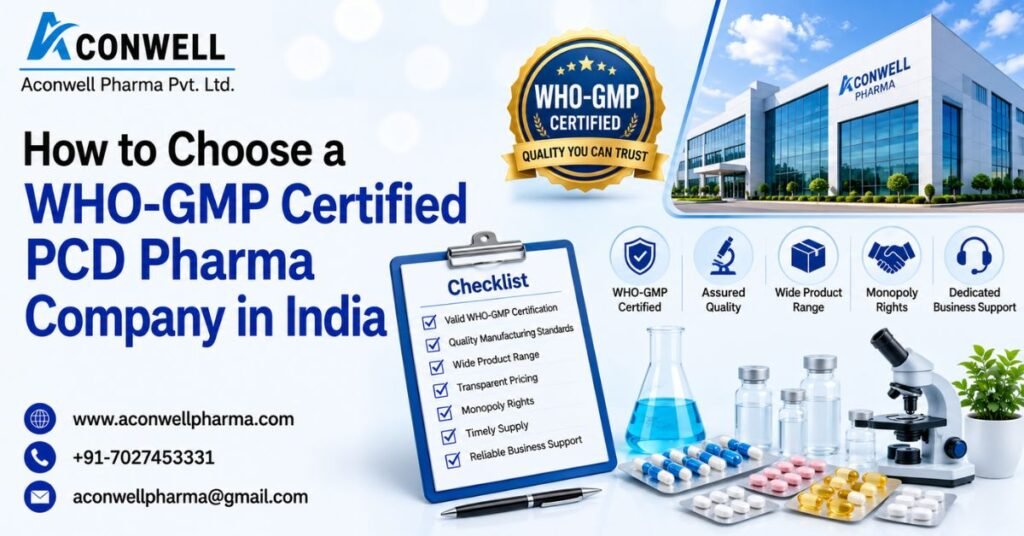
- WHO-GMP certificate — verify the number yourself on CDSCO or your state authority’s site. Don’t take the company’s word for it.
- Drug Manufacturing License, checked separately. This is not the same paper as the WHO-GMP certificate, and companies sometimes only show you one.
- Monopoly rights, in writing, with your exact territory named
- Printed price list — get it before you commit, not after
- Product range that fits what doctors in your area actually prescribe
- Marketing support in writing. A verbal promise of visual aids and sample kits means nothing once you’ve signed.
- MOQ that matches what you can actually sell, not what sounds good in the pitch
- Delivery timeline, and a clear policy on returning expired stock
- Call two existing partners. Not “ask for references” — actually call them.
- Exit terms, read before signing
2026 Trends in PCD Pharma Franchise Business
A few shifts are shaping how franchise partners operate this year, worth factoring into any decision:
- Digital-first doctor outreach is supplementing traditional MR visits, with companies increasingly providing digital visual aids and WhatsApp-based catalogs alongside physical promotional material.
- Documentation transparency has become a differentiator. Companies that make certificates, price lists, and agreements easy to verify upfront are winning franchise partner trust faster than those relying on reputation alone.
- Tier 2 and Tier 3 market expansion continues to be where much of the new franchise territory is opening up, as healthcare access grows outside metro areas.
- AI-assisted search behavior means more prospective franchise partners are researching companies through detailed, comparison-style content before ever making contact — which is pushing manufacturers to publish clearer, more verifiable information rather than generic sales copy.
Frequently Asked Questions
Q1. What does WHO-GMP certification actually guarantee for a PCD franchise partner?
Ans. It confirms the manufacturing facility meets internationally recognized standards for production, testing, and storage — which directly reduces your risk of product complaints and returns.
Q2. How do I verify if a company is truly WHO-GMP certified?
Ans. Request the certificate number and independently check it against your state Drug Control Department’s database or the CDSCO central registry. A genuine certificate holder will never hesitate to share this.
Q3. What’s the difference between a PCD franchise and third-party manufacturing?
Ans. A PCD franchise gives you monopoly rights to market and sell an existing product range under the company’s brand. Third-party manufacturing means the company produces medicines under your own brand name instead.
Q4. Should price be the main factor in choosing a franchise partner?
Ans. No. Certification, consistent product quality, and reliable support matter more than a marginally lower price — quality issues down the line typically cost far more than the initial savings.
Q5. Is DCGI approval the same as WHO-GMP certification?
Ans. No. DCGI (Drugs Controller General of India) approval clears a specific product for sale in India. WHO-GMP certifies the manufacturing facility itself. A trustworthy partner will have DCGI-approved products coming out of a WHO-GMP-certified unit — both matter, and they answer different questions.
Conclusion
Choosing a WHO-GMP certified PCD pharma company comes down to five checkable things: verified certification, a product range that matches your market, monopoly rights in writing, transparent pricing, and real marketing support. None of these require guesswork — every one of them can be confirmed before you sign anything.
Take the ten minutes to verify the certificate. Call the reference partners. Read the agreement fully before committing. The franchise partners who skip these steps are usually the ones calling customer support with complaints six months in — the ones who don’t are running steady businesses two years later.