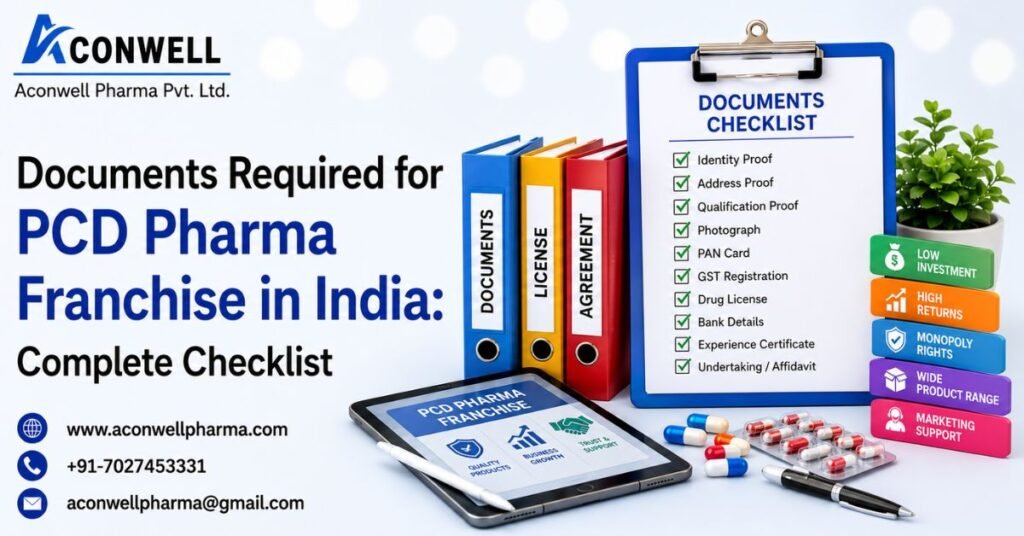
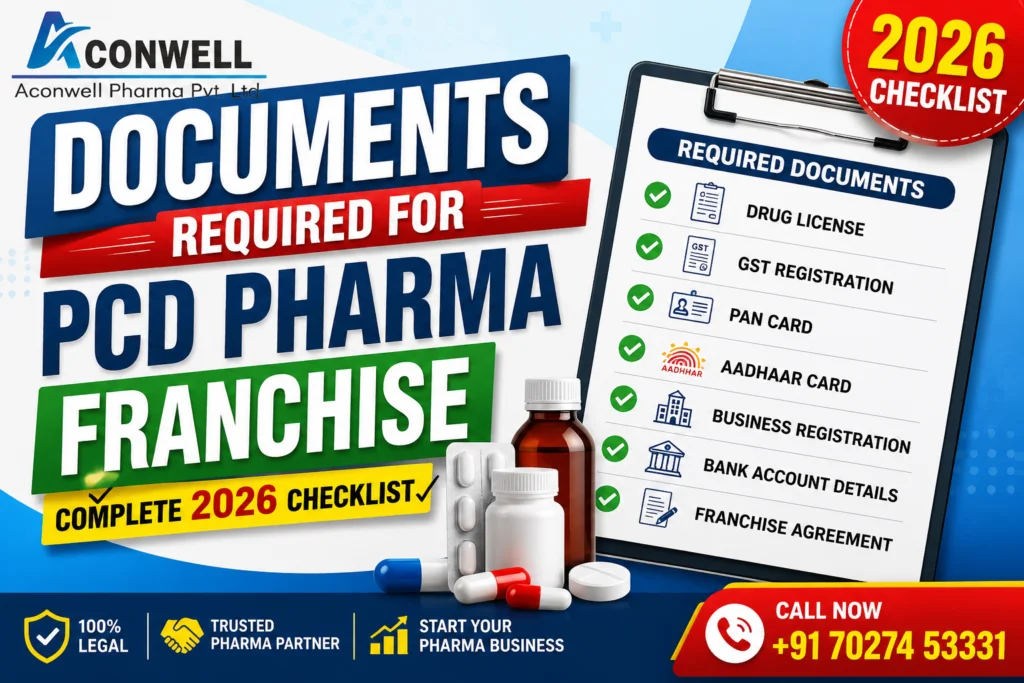
Quick Answer: Documents Required for PCD Pharma Franchise in India.
A Wholesale Drug License, GST registration, PAN, address proof, and a signed franchise agreement are the non-negotiables for starting a PCD pharma franchise in India. Depending on your business structure and product range, you’ll also need business constitution proof, a pharmacist/competent person certificate, a monopoly rights letter, and — only if you’re distributing nutraceuticals alongside medicines — an FSSAI license.
Most first-time applicants don’t get rejected because their business idea is weak. They get delayed for weeks because one document was missing, expired, or submitted in the wrong format. This guide covers every document a PCD (Propaganda Cum Distribution) pharma franchise actually needs in 2026 — including the ones that trip people up after the obvious four.
Why Documentation Actually Matters Here
Medicines are a regulated product category, so this isn’t paperwork for its own sake. The CDSCO (Central Drugs Standard Control Organisation), the Ministry of Health and Family Welfare, and your state’s Drug Control Department all have a direct stake in knowing who’s distributing drugs and under what accountability.
There’s also a 2026-specific factor: UCPMP 2024 (Uniform Code of Pharmaceutical Marketing Practices) is now in effect. It governs marketing conduct — accurate product claims, limits on promotional freebies to doctors, and how franchise agreements frame promotional commitments. It doesn’t add a new document to your checklist, but pharma companies are now checking that your franchise agreement and marketing conduct align with it before they sign.
Get the paperwork right the first time and you get faster approvals, easier access to credit, and companies willing to hand you exclusive territory. Get it wrong and you’re refiling forms while someone else picks up your district.
Complete Document Checklist for a PCD Pharma Franchise (2026)
1. Drug License
Nothing substitutes for this one. It’s issued under the Drugs and Cosmetics Act, 1940 by your State Drug Control Department — without it, no pharma company will send you a product list, let alone sign an agreement.
| License Type | Form No. | What It Covers |
|---|---|---|
| Wholesale Drug License | Form 20B & 21B | Supplying to hospitals, clinics, and chemists — this is the one a PCD franchise needs |
| Retail Drug License | Form 20 & 21 | Selling directly to patients over the counter |
You’ll typically need at least 10 square meters of storage space, a refrigerator for temperature-sensitive medicines, and either a registered pharmacist or someone with documented drug-distribution experience on record.
2. GST Registration
Mandatory for anyone selling or distributing pharmaceutical products — there’s no turnover exemption specific to this trade. Register at gstin.gov.in. Most pharma products fall under the 5% or 12% GST slab, and this registration is what lets you issue tax invoices and claim input tax credit.
3. PAN Card — Personal and Business
Your PAN ties into every financial transaction: bank account, GST registration, tax filing, transactions with the pharma company. If you’re applying as a partnership or private limited company, the firm needs its own PAN — your personal one doesn’t cover it.
4. Identity Proof
Aadhaar, Voter ID, Passport, or Driving License — any one confirms who you are as the business owner. Most companies ask for at least two.
5. Business Address Proof
Both your drug license and GST registration require proof of your operating premises — electricity bill, property tax receipt, rent agreement, or ownership documents. If the premises are rented, add a No Objection Certificate (NOC) from the landlord. This is the single most common reason applications stall — people forget it exists until the process is already delayed.
6. Business Constitution Proof
Generic checklists skip this one, but pharma companies now ask for it as standard. What you need depends entirely on your business structure:
| Business Type | Required Document |
|---|---|
| Proprietorship | Udyam (MSME) Registration or proprietorship declaration |
| Partnership Firm | Registered Partnership Deed |
| Private Limited Company | Certificate of Incorporation, plus MOA and AOA |
| LLP | LLP Agreement and Certificate of Incorporation |
7. Pharmacist or Competent Person Certificate
A registered pharmacist, or someone with at least a year of documented drug-distribution experience, must be named as responsible for medicine storage and handling. Regulators want a trained, accountable individual on record — not just a business owner holding a license.
8. Bank Account Details and a Cancelled Cheque
A current account in the business’s name — not a personal savings account. Most companies now request a cancelled cheque specifically because it speeds up their internal verification and payment setup. Skipping this causes delays even when every other document checks out.
9. PCD Pharma Franchise Agreement
Once your registrations are in place, this contract formally starts the business relationship — territory rights (monopoly or non-monopoly), pricing, payment terms, and marketing support commitments. Read the territory clause especially closely; that’s where most disputes originate later.
10. Monopoly Rights Letter — For Exclusive Territory
Want your district free of competing franchisees from the same company? That requires a separate, written Letter of Monopoly Rights defining the exact boundaries. Don’t assume monopoly is implied just because no one else has been appointed there yet — get it documented.
11. Non-Disclosure Agreement
Covers pricing structures, marketing strategy, and sometimes formulation details. Usually a formality, but read it fully — some NDAs quietly extend to cover product complaint data too, which matters if a dispute arises later.
12. Product Supply Agreement
A separate document from the main franchise agreement, easy to overlook since the two overlap on paper. This one gets specific — minimum order quantities, delivery timelines, and how pricing gets revised. Smaller companies often fold this into the main agreement; larger ones issue it separately, which is generally the better arrangement, since vague pricing-revision terms are where most franchisee-company disputes start.
13. Trademark Authorisation Letter (Optional)
Allows use of the company’s brand name in local marketing — signage, visiting cards, promotional material — without it counting as unauthorized use. Not every company issues one, but if yours does, keep it on file as proof of authorized status.
14. FSSAI License — Only for Nutraceuticals
Purely pharmaceutical range? Skip this. But the moment your product list includes protein powders, supplements, or anything classified as “food” rather than “drug,” FSSAI registration becomes mandatory alongside your drug license. Franchisees often miss this because they still think of their business as “medicines” even after the product list has expanded.
15. Storage and Infrastructure Proof
Not a document you submit upfront, but inspectors verify it before finalizing your drug license: proper storage racks, temperature-controlled space, refrigeration for vaccines and injections, and clean, hygienic storage conditions.
Quick Reference: Mandatory vs. Conditional Documents
| # | Document | Status | Issued By |
|---|---|---|---|
| 1 | Wholesale Drug License (Form 20B/21B) | Mandatory | State Drug Control Dept. |
| 2 | GST Registration Certificate | Mandatory | GST Department |
| 3 | PAN Card (individual + firm) | Mandatory | Income Tax Dept. |
| 4 | Aadhaar/Voter ID/Passport | Mandatory | Govt. of India |
| 5 | Address Proof + Rent Agreement/NOC | Mandatory | Local Authority/Landlord |
| 6 | Business Constitution Proof | Mandatory | MCA/Registrar |
| 7 | Pharmacist/Competent Person Certificate | Mandatory | Pharmacy Council |
| 8 | Bank Account + Cancelled Cheque | Mandatory | Bank |
| 9 | Franchise Agreement | Mandatory | Pharma Company |
| 10 | Monopoly Rights Letter | Conditional | Pharma Company |
| 11 | NDA | Conditional | Pharma Company |
| 12 | Product Supply Agreement | Conditional | Pharma Company |
| 13 | Trademark Authorisation Letter | Optional | Pharma Company |
| 14 | FSSAI License | Conditional (nutra range only) | FSSAI |
| 15 | Storage Infrastructure Proof | Mandatory | Self-declared/Inspection |
How the Process Actually Runs, Step by Step
- Research your local market and decide which therapy segment or product range fits it.
- Apply for a Wholesale Drug License through your state drug authority.
- Register for GST.
- Open a current bank account under the business name and get a cancelled cheque ready.
- Set up storage — racks, refrigeration, ventilation — before inspection, not after.
- Shortlist a pharma company and check their product list and monopoly policy before committing.
- Submit your documents and sign the franchise agreement.
- Finalize the monopoly letter and product supply agreement, if applicable.
- Start marketing and get products moving in your territory.
Company vs. Individual: What Changes
| How You’re Applying | Extra Documents Needed |
|---|---|
| Individual/Proprietor | Udyam Registration, personal PAN and Aadhaar |
| Partnership Firm | Registered Partnership Deed, firm PAN |
| Private Limited Company | Certificate of Incorporation, MOA, AOA, Board Resolution |
Mistakes That Get Applications Rejected or Delayed
- Rent agreement expired, or no NOC from the landlord
- Applying with a Retail Drug License when the company requires Wholesale
- Submitting only a personal PAN instead of the firm’s PAN
- Storage space under the 10 sq. meter minimum
- Signing the franchise agreement without reading the territory clause closely
- Skipping the cancelled cheque, which quietly delays payment setup
How Long Does Approval Actually Take?
There’s no single fixed timeline — any guide claiming otherwise is guessing. Three things determine speed: how quickly your Drug License and GST registration come through (state-dependent, typically 2-4 weeks for the license alone), whether your first document submission is complete, and how fast the pharma company processes territory checks. Applicants who submit a complete document set the first time — no missing NOC, no expired rent agreement — routinely move through the process weeks faster than those correcting partial paperwork in rounds.
Bottom Line
The four documents everyone mentions — Drug License, GST, PAN, and address proof — get you started, but they won’t get your franchise agreement signed on their own. Companies in 2026 also expect business constitution proof, a cancelled cheque, and clarity on monopoly and supply terms before committing territory to you. Get all fifteen documents in order before approaching a company, and you’ll cut weeks off a process that trips up most first-time applicants.
Regulations vary slightly by state, so confirm current requirements with your local Drug Control Department before filing anything.
Frequently Asked Questions
Q1. What’s the single most important document for a PCD pharma franchise?
Drug License and GST registration. Without either, most companies won’t process your application — every other document fills in the rest of the paperwork trail.
Q2. Can an individual start a PCD pharma franchise without forming a company?
Yes. As a proprietor, Udyam registration plus your personal PAN and Aadhaar cover the business-constitution requirement.
Q3. How much investment does a PCD pharma franchise need?
Investment usually starts from ₹30,000 to ₹1,00,000, depending on the product range and how many therapy segments you’re covering at launch.
Q4. Is an FSSAI license required for every PCD franchise?
Only if you’re distributing nutraceuticals, supplements, or other food-category products alongside medicines.
Q5. What’s the difference between Retail and Wholesale Drug License?
Retail (Form 20/21) is for selling directly to patients. Wholesale (Form 20B/21B) is for supplying hospitals, clinics, and chemists — that’s the one PCD franchises need.
Q6. Do I need a separate document for monopoly rights?
Yes — a Letter of Monopoly Rights, issued by the company, spelling out your exclusive territory. Don’t rely on a verbal understanding.
Q7. How long does the approval process typically take?
It varies by state and by how complete your first submission is — expect roughly 3-6 weeks total when your Drug License, GST, and business documents are in order from the start. Incomplete submissions can push this well past two months.
Q8. Do I need different documents if I want to expand into another state later?
Possibly. Drug licensing requirements are state-specific, so expanding your territory into a new state may require an additional Wholesale Drug License and, depending on how your business is structured, further state-level registrations.